by Barb Perkes | Jul 2, 2020 | Articles, News, Uncategorized
Doug Hubbard and his team’s work is mentioned in high regard often in articles, by peers and clients alike. Perhaps it’s because HDR utilizes native Excel to create custom automation models for each client’s specific needs – without any limitations of an existing software solution and without annual licensing or subscription fees that often come along with traditional software solutions.
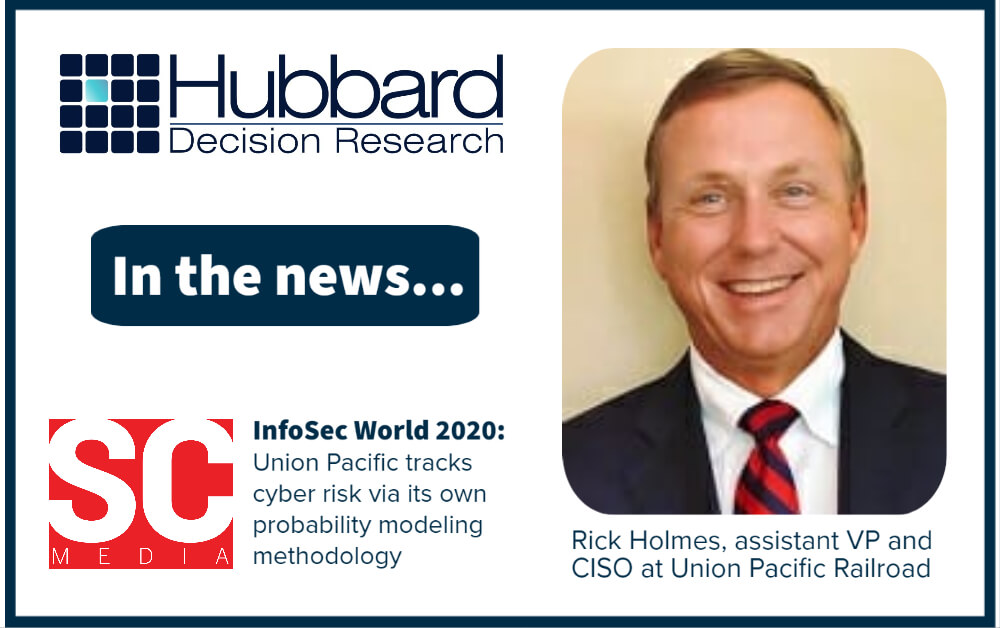
This week an article in InfoSec 2020 was brought to our attention where Doug is mentioned specifically by the Union Pacific CISO, Rick Holmes. Union Pacific is the second largest railroad system in the United States and is one of the largest transportation companies in the world.
A portion of the article reads, “UP assesses and analyzes risk from four different perspectives – those of an insurance company or actuarial expert, a compliance auditor, a legal advisor and the mind of an attacker. Key to the process, however, is the risk probability modeling that the cyber risk assessment team developed in order to statistically convey to upper management the likelihood of a cyber event occurring and the calculable monetary loss that would result.
For this, UP recruited management consultant and author Douglas Hubbard, who helped devise a framework that analyzed and categorized UP’s computing environment into various asset classes.”
Read the full article here.

by Barb Perkes | Jul 1, 2020 | Articles, News
Doug Hubbard developed the Applied Information Economics (AIE) methodology over two decades ago and it has been his life’s work ever since. During that time he has been across the globe and back again consulting with various departments and functional groups within local, regional, national and global organizations and across dozens of industries.
It was requests from our clients that started our journey of developing webinars and teaching the AIE concepts to their new employees, which evolved into the ability to reach a much broader audience. With an ever-growing global client base, it has become increasingly challenging to create course times to suit everyone’s schedule.
This is why HDR is so excited to introduce, The AIE Academy. This new online learning portal will eventually allow 24/7, global access to the majority of our powerful, world class training per your schedule, not ours.
Watch this quick intro video below to learn more before clicking here to visit The AIE Academy page.

by Barb Perkes | Jun 9, 2020 | Articles, News
Even excluding the value of other strategy improvements, the AIE methodology provided a 300:1 payback for the VA. The document below is meant to serve as a summary of an actual case study we performed for the Veterans Administration. While some sections of the original document have been omitted due to length, and/or renumbered, no information contained within has been edited.
Please note pages 1-3 are verbatim from the client. All other sections of the document were completed by Doug Hubbard with the assistance of the VA staff participating in the study.
Please contact us at info@hubbardresearch.com to request the original document in its entirety or to set up a call to learn more about what we can do for you. Click the link below to view the summary document.
VA_Measuring IT’s Contribution to Mission Results_HDR1
by Barb Perkes | May 26, 2020 | Articles, News
“In an effort to provide a current picture of COVID-19 to help our members in their decision making processes, GFOA partnered with Hubbard Decision Research.”
Matt Millar, Sr. Quantitative Analyst, has been acclaimed for his COVID-19 forecasting since January of 2020. Matt and Doug Hubbard provided a live webinar back on May 11th to the GFOA regarding the virus, the accuracy of the data and how public finance appears to hang in the balance of governmental response. HDR now extends that partnership with the GFOA by providing ongoing COVID-19 forecasts for it’s over 20,000 strong membership.
See the latest HDR COVID-19 Prediction Model (5/21/20 through 6/18/20) here.
by Barb Perkes | May 5, 2020 | Articles, News
HDR is proud to announce a timely collaboration with the Government Finance Officers Association (GFOA). Founded in 1906, the GFOA represents public finance officials throughout the United States and Canada and has readily accepted the leadership challenge of public finance. Its more than 20,000 members are federal, state/provincial, and local finance officials deeply involved in planning, financing, and implementing thousands of governmental operations in each of their jurisdictions.
Webinar Date & Time: Monday, May 11th, 1pm – 2pm CDT CPE Credits: 1
Webinar Objectives: Those who successfully complete this webinar should obtain a solid understanding of each of the following:
- Learn the most important metric for the current level of public safety and contagion risk.
- Learn the important pitfalls to watch in how the spread/prevalence of COVID-19 is commonly reported.
- Learn to separate the wheat from the chaff in COVID-19 reporting and statistics.
- Be aware of the early indicators for possible resurgence in your region.
Doug Hubbard (President) and Matt Millar (Sr. Quantitative Analyst) will cover how COVID-19 data, stories and reporting are pervasive, yet incomplete, and how public finances appear to hang in the balance of governmental response. HDR has been acclaimed for their COVID-19 forecasting since January 2020. However, both HDR and the GFOA know financial officers need more that just accurate data to make the best financial preparations and decisions for their communities, they need the 21st century tools to use it.
Learn more here.
by Barb Perkes | Apr 29, 2020 | Articles, News
ISACA is an international professional association focused on IT governance. It was known as the Information Systems Audit and Control Association, although ISACA now goes only by its acronym.
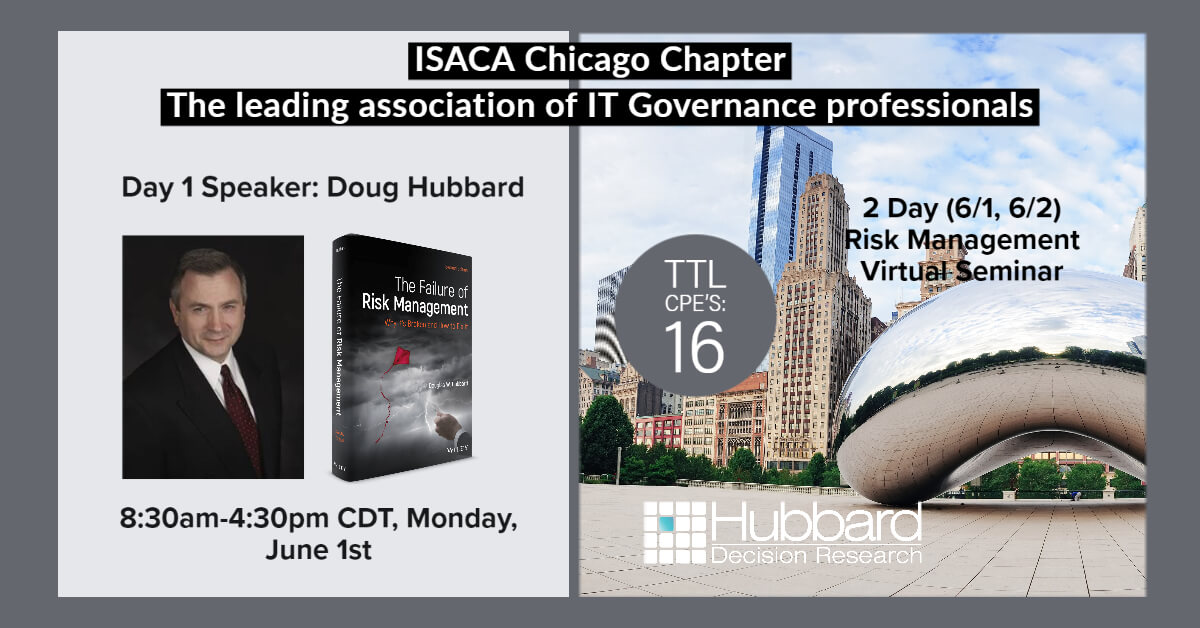
On day one, Monday June 1st, of the ISACA two-day (6/1, 6/2) risk management virtual seminar, Doug will lead a webinar from 8:30am – 4:30pm CDT, based on the 2nd edition of his book, The Failure of Risk Management. Doug is the creator of the quantitative risk assessment methodology, AIE (Applied Information Economics). The AIE method is used by Fortune 500 companies, federal and state governments, the U.S. military, and leading multi-national corporations across the globe.
Doug’s webinar will guide you through how risk management is failing today, including taking a look at the critical flaws of existing methods and how in the 21st century these antiquated models expose organizations to even greater risk. Participants will also learn what they can do to improve their risk management systems by using proven, quantitative methods to reduce uncertainty and make better decisions. (8 CPEs)
The ISACA community is guided by a purpose and promise, which defines the essence of who they are and what they do. Their purpose is the reason they exist—to help business technology professionals and their enterprises around the world realize the positive potential of technology. Their promise is how they, as an organization and as individuals, deliver on their purpose: inspiring confidence that enables innovation through technology.
ISACA has served their professional community for more than 50 years. The association was incorporated as the EDP Auditors Association in 1969 by a small group of individuals who recognized a need for a centralized source of information and guidance in the new field of electronic data processing audit. Today, ISACA serves 145,000 professionals in 180 countries, who span several roles in assurance, governance, risk and information security.
Click here to learn more and register.

by Barb Perkes | Apr 21, 2020 | Articles, News
Doug Hubbard joins other Probability Management global thought leaders in a live panel discussion with the brilliant Professor Ron Howard today, 4/21/20, from Noon-1:30pm CDT.
For Ron, it all started with a seminal 1966 article entitled “Information Value Theory.” Professor Howard of Stanford University is the inventor of the Value of Information and founder of the field of Decision Analysis. Today he leads a 90-minute discussion as he talks about his long and distinguished career in Decision Analysis.
Professor Howard will be joined by Dr. Sam Savage, Executive Director of ProbabilityManagement.org and author of The Flaw of Averages; our very own Doug Hubbard, founder of Hubbard Decision Research, Chair of Decisions and Measurements at ProbabilityManagement.org, and author of multiple books about measurement, risk, and decision making; and Tom Keelin, principal of Keelin Reeds Partners, inventor of the Metalog distribution, and Chief Research Scientist at ProbabilityManagement.org.
There is a cost involved to join this live webinar with these notable industry experts. If you are interested to learn more click here.

by Barb Perkes | Apr 17, 2020 | Articles, News
(Written by Doug Hubbard)
COVID-19 risks are forcing a lot of firms to implement work-from-home policies. We have some ideas about how to make that work. Like a lot of small consulting firms, the team at Hubbard Decision Research has been working remotely for years, as compared to full time employees and part time subcontractors who have had to go to an office building to work.
For some, working from home may produce distractions that reduce productivity. Managers may feel that, without direct observation, their teams will take advantage of the situation. There are certainly different challenges for working remotely but they don’t have to include reduced productivity. In fact, the flexibility of not spending time in a daily commute could improve productivity if you approach it with well-defined expectations.
Here are a few keys to successful management of remote workers:
1. Manage by deliverables: You never needed to be looking over your team’s shoulder to ensure they do work, anyway. For one thing, it undermines a sense of trust that is important to work environments. Plus, there is a better way to observe productivity – their actual output. All tasks should have a deliverable, that is, some sort of documented evidence that the work was done. If you assign someone a task to proofread a document, the deliverable should include, the modified document itself, the list of changes and a statement that they feel confident that they have caught everything. Whether the task is writing code, completing a cost benefit analysis, or finishing a presentation, you always want the output anyway. Exactly how long it took my team to do a task is really no concern to me as long as the deliverable met or exceeded expectations and it was done on time. Documented work is also the best data for evaluation of their performance.
2. Set availability expectations: If you would normally be 9am to 5pm in your office, make the same rules for remote work. If someone is gone for personal reasons, that needs to be on their calendar. If there is nothing on their calendar and they don’t pick up when you call, state the rule for how soon they should be expected to return the call (e.g. 10 minutes).
3. Keep brief but regular meetings with the team. To get them started on time and manage expectations, it’s often useful to have a quick team meeting. Keep them short and don’t let them turn into a waste of time. Get to the point. Review priorities and expected deliverable times for the day and let them loose.
4. Use collaborative tools. We like to use Slack and Webex for starters.
In short, the most successful tactics that effect remote work are the same as what works face-to-face. Set expectations, deliver evidence of work and stay connected. If anything, the only difference with remote work is that it may force you to communicate even more than you otherwise would have to make sure you stay productive.

by Barb Perkes | Apr 9, 2020 | Articles, News
ResearchGate is sort of a “LinkedIn” for authors and researchers where they can post their published work.
Congratulations to Doug Hubbard, whose various books and articles have been currently cited 1000 times by other published works. Considering Research Gate depends on authors submitting their bibliographies, this is likely a conservatively low estimate.
Doug Hubbard is a Global Thought Leader and heads up the Quantitative Analysis Consultancy, Hubbard Decision Research, outside of Chicago, IL. He teaches, consults and provides tools on how to apply his proprietary method, AIE (Applied Information Economics), in order to measure what matters across any industry and in various disciplines. He works across the globe in building better decision makers. Doug has authored articles in distinguished publications and has written 5 books in eight languages that have sold over 150,000 copies.
- How to Measure Anything: Finding the Value of Intangibles in Business (one of the all-time, best-
selling books in business math)
- The Failure of Risk Management: Why It’s Broken and How to Fix It (1E/2E)
- Pulse: The New Science of Harnessing Internet Buzz to Track Threats and Opportunities
- How to Measure Anything in Cybersecurity Risk (co-authored with Richard Seiersen)
Mr. Hubbard’s books are used as textbooks in dozens of university courses at the graduate level. His first book is required reading for the Society of Actuaries exam prep. His fourth book won the Palo Alto Networks Cybersecurity Canon award. Doug is published in the prestigious science journal, Nature, in additions to publications as varied as The American Statistician, CIO Magazine, Information Week, DBMS Magazine, Architecture Boston, OR/MS Today, The IBM Journal of Research and Development and Analytics Magazine.
Learn more about his books here: https://hubbardresearch.com/publications/

by Barb Perkes | Apr 8, 2020 | Articles, News
Follow us on our newly consolidated Twitter account @HubbardDecision.
One lucky follower will win a free, signed copy of Doug’s new book, The Failure of Risk Management 2E! The winner will be announced June 30th, 2020.